
Virginia Haufler is a Professor in the Department of Government and Politics at the University of Maryland, College Park, and an associate of the Center for International Development and Conflict Management. She was a 2022-23 Fulbright Canada-Pierre Elliott Trudeau Fellow, residing in Montréal, in fall 2022 where she held the Joint Chair in Contemporary Policy at the McGill Institute for the Study of Canada. She currently is a Pierre Elliott Trudeau Fellow 2023-25.
She is Director of GVPT Global, which supports global content and experiential learning for GVPT undergraduates. From 2011-2021 she was Director of the Global Communities Living-Learning Program, which introduces freshmen to scholarship and experiences that explore globalization, global issues and intercultural understanding.
Dr. Haufler’s research examines the changing nature of governance in the global political economy, focusing on the role of transnational corporations, private governance, and corporate social responsibility. She has published books, chapters, and articles on a wide array of industries and issues, including transnational labor standards, internet privacy, political risk, corporate conflict prevention, and climate change. She has presented her work at conferences, workshops, and public venues around the world.
She has been a visiting scholar at McGill University, University College London, University of California-Irvine, the University of Southern California, the National University of Singapore, Melbourne University, and the Carnegie Endowment for International Peace.
Dr. Haufler has served as advisor, board member, or consultant at a number of non-profit and public service organizations, including Women in International Security, the Sié Center Ethics of Engagement project, the Peace Research Institute-Frankfurt (HSFK), the OEF Foundation, Oxfam International, International Alert, the US Institute of Peace, and the UN Global Compact.
She has a M.A./Ph.D from Cornell University and dual B.A. from Pennsylvania State University.
In her free time, she loves to play the mandolin and indulge her two cats, Suzi and Ollie.


Media

Selected Publications
Global Environmental Politics 10(3), 2010: 53-73
The global promotion of transparency for the extractive sector—oil, gas and mining—has become widely accepted as an appropriate solution to weak governance in resource-rich developing nations.

These beliefs are embodied in the Extractive Industries Transparency Initiative (EITI), initially a unilateral foreign policy effort by the UK under Tony Blair that has evolved into a global program.
Why has transparency become the solution of choice for managing natural resource wealth, and how has the EITI evolved into the institution it has become?

In their place, firms increasingly cooperate internationally to establish the rules and standards of behavior for themselves and for others. Are they stepping into the breach to supply needed collective goods? Or are they organizing themselves in order to prevent governments from interfering in their business?

A Public Role for the Private Sector is the first book to explore this self-regulation phenomenon on an international level across three different policy issues—environment, labor, and information privacy.
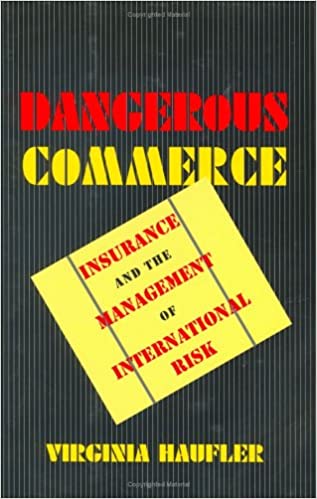
Dangerous Commerce shows that a crucial factor in the expansion of global markets has been the private sector’s creation of a sophisticated insurance industry to redistribute the risks entailed in foreign commerce, a privately constructed safety net for international transactions.
Global Communities Living-Learning Program
- Re-established and revised UMD’s Global Communities Living-Learning Program, a two-year residentially-based undergraduate program open to all majors, supported by the College of Behavioral and Social Sciences.
- Created a freshmen-oriented interdisciplinary social science program focused on globalization, global issues, and intercultural understanding, including a special version of the UNIV100 course for entering freshmen.
- Developed new courses to fulfill a new experiential course requirement, including an internship course and service-learning course, as well as two main required courses.
- Developed a wide range of co-curricular opportunities such as field trips, educational events, and academic support.
- Served as Director of the program from 2011-present.
|

 Virginia Haufler